
Sheridan County Scheduled and Actual Release
A projected date is a calculation based on the controlling sentence and information known at that point. An actual release is the recorded physical movement out of a custodian’s control. Those events may differ. A date can move because credits change, a court modifies a sentence, another case creates a hold, or a planned parole release does not clear all conditions.
Pretrial detention follows court events rather than a served sentence. A person awaiting disposition at Thomas County Jail may leave after bond, dismissal, a court order, or transfer, but has no computed sentence-end date. A sentenced county-jail term follows the journal entry and local calculation. A KDOC term follows Kansas corrections rules. The milestone also matters: leaving prison can begin postrelease supervision, while final discharge ends the correctional obligation.
A court docket may show that an order was entered without displaying the full filed document. Kansas Judicial Branch guidance says some older converted documents require courthouse-terminal access. If the online case lacks the sentence or later modification, contact the Sheridan County District Court in the Fifteenth Judicial District for the record-access route. The actual journal entry controls more than a search-result summary.
Find Sheridan County Projected Release Dates
Sheridan County does not operate a jail listed by KDOC. It contracts with Thomas County Jail in Colby. Start by determining whether the person is at that jail, has been committed to KDOC, or is held elsewhere. The Thomas roster is a current-custody screen, not a historical release archive. KASPER is the state path for a KDOC record.
- Match the person by full name, case number, booking number, or KDOC number.
- For a state prisoner, open the KASPER search and preserve the exact date and status labels.
- For a county sentence, obtain the Sheridan County journal entry and ask the Sheriff or Thomas County Jail for the current computation.
- For a pretrial case, review the Kansas court docket for bond, dismissal, commitment, or release orders rather than seeking a sentence-end date.
- Ask whether another warrant, detainer, or consecutive case prevents community release.
- Confirm the movement with the custodian on the expected day.
The Sheridan County release-record search gives the broader confirmation chain when a person vanishes from a live roster. Disappearance alone cannot distinguish release, transfer, lag, or a name mismatch.
Keep each custody episode separate. A person can be booked, released, and booked again under the same or a different case. Record the booking number, case number, sentence date, and date label together. That prevents a valid date from an older episode from being applied to the current hold.
KASPER Sheridan County Release Records
KASPER is the Kansas Adult Supervised Population Electronic Repository. It can show a matched KDOC person’s status, sentence dates, supervision information, history, and photograph when public. It does not cover an ordinary short Sheridan booking housed under the Thomas County contract, and the public record does not promise a projected date for every person.
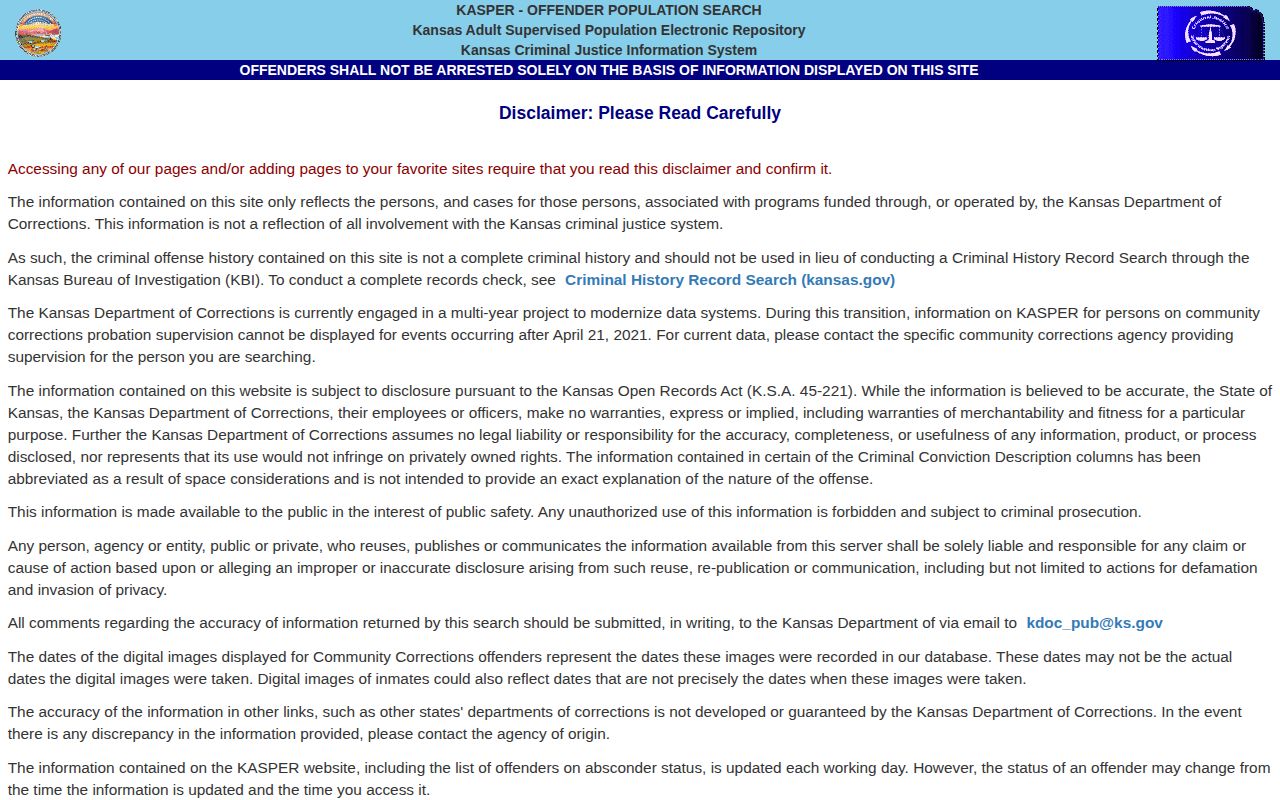
The official KASPER entry page explains the search and its limits. The image below is the successful state search capture listed for projected-release use.
Read each field literally. “Parole eligibility” is an opportunity for board review under an eligible sentence. “Conditional release” is derived under a different rule. “Postrelease supervision” is time in the community after a prison portion. “Discharged” is closer to the end of the KDOC obligation. If the public display does not resolve a conflict, contact KDOC rather than calculating and publishing a homemade date.
Kansas Good Time and Release Dates
Kansas sentence structure depends heavily on offense date and governing law. Many offenses before July 1, 1993 use an indeterminate structure with minimum and maximum terms, parole eligibility, and conditional release. Later grid sentences are determinate and usually have a prison portion followed by postrelease supervision. One percentage cannot accurately describe both systems.
For many covered determinate sentences, K.S.A. 21-6821 caps good-time credit at 15 percent of the prison portion. Full credit can therefore reduce confinement to about 85 percent. The statute also provides 20 percent treatment for specified lower-severity nondrug offenses committed on or after January 1, 2008 and certain drug-grid levels and date ranges. It authorizes up to 120 days of program credit for eligible classes and completions. Credits may be forfeited. Offense-specific provisions can change how earned credit relates to supervision.
The KDOC glossary explains these concepts, while K.S.A. 22-3717 addresses parole and postrelease rules. For an older indeterminate term, retained credit may affect first parole eligibility. Conditional release under K.S.A. 22-3718 concerns a maximum term less applicable retained credits. Eligibility does not promise release, and a board action may still depend on an approved plan and cleared holds.
KDOC identifies its public date field as the anticipated release date. Preserve that adjective whenever the field is copied or discussed. KDOC says the calculation can move when good-time or program credits are earned, forfeited, or restored. Questions about a person-specific computation belong with the KDOC Sentence Computation Unit at 785-296-3317. A public screenshot should keep the date beside the status and sentence context so a changing estimate is not mistaken for a completed exit.
Older indeterminate cases use a different path. K.S.A. 22-3725 supplies part of the earlier good-time framework, while K.S.A. 22-3718 addresses conditional release based on the maximum term less retained work or good-behavior credits. Parole eligibility concerns an opportunity for board action after the applicable minimum calculation. Conditional release and parole eligibility are therefore not alternate labels for the same date. The Prisoner Review Board can find someone eligible yet not suitable and use the exact action terms published for that proceeding.
For determinate cases, credit may advance the end of the prison portion within the governing statute without ending the later postrelease term. Ask whether the desired milestone is departure from prison, the start of community supervision, or final discharge. Each answers a different question.
Sheridan County Jail Credit Calculation
A projected date starts with the sentence and commencement date. K.S.A. 21-6615 makes the sentencing journal entry central because the court designates the computation date and qualifying time spent confined before disposition. It is unsafe to count every calendar day from arrest. Some time may belong to another matter, and concurrent or consecutive sentences can change how credit applies.
County computation is distinct from KDOC computation. A shorter jail sentence is executed under the court’s order, with authorized jail credit and any applicable local or statutory rules. No published Sheridan County written good-time, weekend-release, or holiday-advance policy was found in the reviewed official sources. Obtain the sentence order and ask the Sheridan Sheriff and Thomas custodian for the current calculation. Do not apply the KDOC percentage to a county term.
- Jail credit
- Court-recognized time in custody that applies to a sentence.
- Concurrent
- Sentences that run at the same time as directed by law or court order.
- Consecutive
- Sentences served one after another.
- Detainer
- A request or legal hold that can cause transfer or continued custody.
- Discharge
- The formal end of the sentence or correctional obligation.
Changes to Sheridan County Release Dates
A date can change for reasons found in several records rather than one screen. Compare the journal entry, KDOC record when relevant, discipline or credit action, and any later court order. Ask the custodian about holds without assuming that a projected prison exit means return to Sheridan County.
| Factor | Possible effect | Record to check |
|---|---|---|
| Good-time award | May advance the prison-portion end within the governing rule | KDOC computation |
| Credit loss or restoration | May move a projected date later or earlier | KDOC credit or discipline record |
| Jail credit | Changes credited time before sentence | Journal entry and computation |
| Consecutive case | Can extend total confinement | Sentencing orders |
| Detainer or warrant | Can turn an exit into transfer or continued custody | Custodian and issuing agency |
| Parole action | May grant, pass, defer, or continue an eligible case | PRB action and KASPER |
| Violation or new sentence | Can return a supervised person to custody and alter aggregation | Court or KDOC action |
A postrelease violation may result in confinement, and a new sentence can change the controlling term. Credit often advances the end of the prison portion but does not erase the later supervision period. Ask whether the date means prison exit, start of supervision, or final discharge.
The Prisoner Review Board’s monthly listed-offender material is useful for checking a parole-hearing sequence, but it is not a release calendar. A public-comment month may precede the hearing and a possible-release month. Verify any action in the individual KASPER record or request the board document. “Possible” must remain conditional until custody records show the movement.
Confirm Sheridan County Actual Release
On the expected date, contact the agency that has physical custody. For a Thomas County Jail episode, ask whether the person left, the date and time, the authority, and whether another agency took custody. Pair that answer with the Sheridan court order. For KDOC, compare the live KASPER status with the state record and seek the sentence-computation unit when labels conflict.
Kansas VINE can send custody-change alerts for participating county jails, including the local Thomas County victim-notification route. It expressly excludes KDOC residents in state prisons. The Sheridan County VINELink Check explains registration and the required verification after an alert. Neither an alert nor a missing search result replaces the release transaction.
Federal and immigration custody require separate systems. A federal release date belongs in the BOP locator, while an ICE transfer is checked through the detainee locator and field office. A person can leave one custodian without returning to the community. Record the event and destination before calling it an actual release.