
KDOC Sheridan Release Role
No state prison is identified as physically located in Sheridan County. The Kansas Department of Corrections still becomes central when Sheridan County District Court commits a person to the custody of the Secretary of Corrections or when KDOC later supervises that person in the community. The district-court sentence connects the state episode to Sheridan County.
A move from Thomas County Jail to KDOC is a transfer. The person remains confined under a different custodian. Later departure from a state prison may begin parole or postrelease supervision, which means the person is outside the prison but still within the KDOC correctional term. “Discharged” is different. It indicates that the correctional obligation shown by KDOC has ended.
| Event | Custody meaning | Best record |
|---|---|---|
| Thomas County to KDOC | State transfer, not community release | Jail transfer, court commitment, and KASPER |
| Prison to parole | Community release with active supervision | KASPER and Prisoner Review Board action |
| Prison to postrelease | Statutory supervision after the prison portion | KASPER and KDOC sentence record |
| KDOC discharge | End of the correctional obligation shown | KASPER plus KDOC discharge record when needed |
Search KDOC Release Records
Enter the official KASPER search through its disclaimer. KASPER covers people sentenced to the Secretary of Corrections since 1980 who are incarcerated, on post-incarceration supervision, or discharged. It is not a second Sheridan County jail roster. A person booked briefly and released on bond may have no state corrections record unless a separate KDOC history already exists.
- Accept the KASPER terms and search with the most exact name available. Use the KDOC number when known because it is the strongest match.
- Compare identity fields and aliases before opening a record. Similar names can produce the wrong state history.
- Match the county of conviction, case, offenses, and sentence dates to the Sheridan County court episode.
- Read status, current location, supervision type, and date labels together. Do not rely on one field in isolation.
- Preserve words such as “anticipated,” “parole,” “postrelease,” and “discharged” exactly because they describe different milestones.
The Sheridan County released-inmate search remains the correct route for an ordinary county booking. KASPER should lead only when the court record, jail transfer, or known state sentence makes KDOC relevant.
KDOC Release Search Fields
KDOC’s locator materials describe a broad set of search controls and result fields. Search options can include name, aliases, KDOC number, demographic or physical traits, conviction county, facility, supervision type, community-corrections location, and parole-supervision county. Sheridan can be used as a county filter, but a filter alone does not prove that every displayed state event arose from the local case.
| KASPER information | How to read it |
|---|---|
| Name, aliases, and KDOC number | Resolve identity before using the state history |
| Conviction county and case | Connect the record to Sheridan County |
| Current location or facility movements | Show state custody or movement, not a county release |
| Supervision type and parole office | Show community status after prison when public |
| Anticipated release date | Show a changeable estimate rather than an accomplished event |
| Status and discharge information | Distinguish active custody, supervision, and a completed KDOC obligation |
The official KASPER entry screen shows the state search starting point used for Sheridan County KDOC release records.
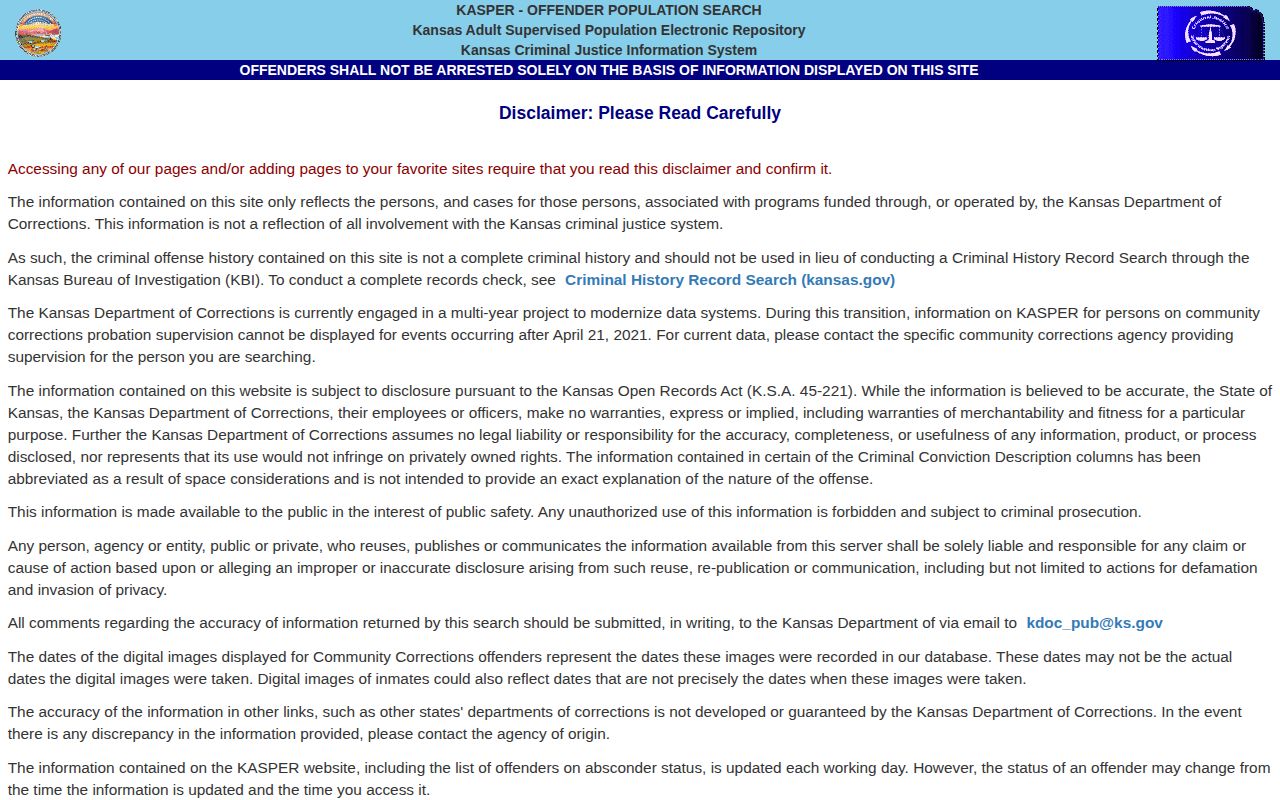
The screen leads into the statewide record search; the selected person result must still be matched to the Sheridan County conviction and read for its exact status.
KDOC says KASPER data updates daily except weekends. A recent movement may therefore take time to appear. Verify urgent or unclear status through KDOC rather than trying to infer it from a blank field. The public record may also omit a protected supervision address even when it shows the correct supervision type.
KDOC Release Dates Explained
The official locator uses the label “Anticipated release date.” That word matters. Credits earned or lost, court changes, revocations, warrants, sentence aggregation, other holds, and disciplinary decisions can move the date. A future date should never be rewritten as the day someone will certainly leave. The Sheridan County projected release date coverage explains the state calculation in more depth.
Kansas sentence structure depends on the offense date and governing law. Many later grid sentences are determinate, with a stated prison portion followed by postrelease supervision. Older indeterminate sentences use concepts such as parole eligibility and conditional release. Parole eligibility creates an opportunity for a board decision; it is not a guaranteed departure date.
- Anticipated release
- A changeable state computation based on the controlling sentence and applicable credits.
- Parole
- A discretionary community release for a parole-eligible sentence, with supervision still active.
- Postrelease supervision
- A supervision period that follows the prison part of a determinate Kansas sentence.
- Conditional release
- A statutory release point for covered older indeterminate sentences based on the maximum term and retained credits.
- Discharge
- The end of the KDOC correctional obligation shown by the official record.
The question “when is the person free?” can refer to three separate dates: departure from a prison, the end of active supervision, or final discharge. Ask which milestone is intended, then retain the exact label from the official record.
KDOC Release Credit Rules
For many covered determinate sentences, the familiar estimate that a person may serve about 85 percent of the prison portion comes from good-time credit capped at 15 percent. That is not a universal promise. Kansas law has offense-date, severity, and sentence-specific exceptions, including some provisions with different credit treatment and authorized program credits.
K.S.A. 21-6821 and K.S.A. 22-3717 must be read with the actual sentence and offense date. Credits can be forfeited. Court-ordered jail credit, concurrent or consecutive terms, sentence modifications, revocation, and another hold can also alter the state computation. A homemade date based only on arrest and sentence dates is not reliable.
KDOC directs detailed calculation questions to its Sentence Computation Unit at 785-296-3317. Use the sentencing journal entry and the controlling-sentence information when raising a discrepancy. Court records establish what the judge ordered, while KDOC applies that order within the state computation system.
Request KDOC Discharge Records
KASPER is a public index, not the full KDOC file. KDOC’s KORA brochure identifies public information that can include physical description, conviction history, controlling sentence and sentence-begin date, institutional disciplinary information, and a photograph. When a precise discharge, movement, or sentence-computation record is needed, use the current KDOC contact directory to find the proper records channel.
Kansas Department of CorrectionsStatewide corrections system
Use the current KDOC contact directory for central-office, records, and field-services routing.
Sentence Computation Unit: 785-296-3317
A focused request should identify the person by name and KDOC number, state the date range, and name the existing record sought. Useful items may include the controlling-sentence record, movement entry, supervision status, release action, or discharge record. Ask for electronic copies and a fee estimate before unapproved costs. Do not send extra identifiers that are not needed to locate the record.
The Sheridan County court record is a separate source. Use the district court for the commitment and sentencing journal entry that created the state term. KDOC can explain its computation and custody status, but it does not replace the court’s own filed order.
KDOC Sheridan Supervision Status
Leaving prison on parole or postrelease supervision is an actual release from the building but not a final discharge. KASPER may show a community location, supervision type, or parole office. KDOC Community and Field Services handles parole and postrelease supervision, while the Prisoner Review Board makes parole-release decisions for eligible cases. Court Services or community corrections may supervise other probation populations.
Do not use KASPER as a universal probation database. KDOC warns that some community-corrections events after April 21, 2021 may not display during system modernization. Verify court probation through the Sheridan County case and the supervising agency named by the order. A specialized KDOC absconder result signals a supervision problem after release, not proof that the prior release never occurred.
Note: A supervision office is an agency contact point, not permission to publish or infer a person’s private residence.
KDOC Versus County Releases
A Thomas County Jail release record and a KDOC record answer different questions. Thomas County documents the Sheridan contract prisoner’s physical admission and exit. KASPER documents the state corrections episode after a commitment. The district court links both to the legal case. A missing name on the Thomas roster can justify checking KASPER, but it cannot by itself prove a state transfer.
Likewise, an old KASPER record may be accurate yet unrelated to the current Sheridan arrest. Match conviction county, case, offense, and dates. If Thomas County says the person went to KDOC, then the jail transfer and state admission should form a coherent sequence. If the person was released on bond after a short stay, no new KDOC entry should be expected.
KDOC Release Search Boundaries
KASPER does not cover BOP prisoners, ICE detainees, every county booking, or every form of court probation. Use BOP only for a confirmed federal sentence or transfer. Use ICE’s locator only after an immigration handoff is confirmed. Kansas VINE covers participating county-jail records and expressly excludes residents housed in KDOC state prisons; KDOC Victim Services operates a separate state notification program.
KASPER names can remain visible after discharge because the system preserves state correctional history. KDOC says removal may occur in limited situations such as an overturned conviction, expungement, or executive clemency. A searchable historical record should not be mislabeled as current custody. Read the status and dates before drawing any conclusion.
Note: No state prison is physically identified in Sheridan County, so this facility page describes the statewide system serving local state-sentence cases.