
Sheridan County Parole and Probation
Parole and probation both let a person live in the community under rules, yet they arise from different decisions. Parole is a release from prison under an older eligible sentence after action by the Kansas Prisoner Review Board. Postrelease supervision follows the prison portion of many later determinate sentences. KDOC Community and Field Services supervises both groups. Probation usually comes from a Sheridan County court sentence that allows community supervision instead of all or part of a jail or prison term.
The distinction matters because no one search covers every track. KASPER, the Kansas Adult Supervised Population Electronic Repository, is the proper starting point for a KDOC case. A Sheridan County District Court order is the better starting point for court probation. Community corrections may supervise a qualifying higher-risk felony probation case, while Court Services can supervise another court probation case. The parole board does not run all probation.
A release record may use only a short label. Read it with the sentence, not in isolation. “To probation” points toward a court order. “To parole” or “postrelease” points toward a KDOC record. A transfer to KDOC is still custody, even if Thomas County records an exit. These differences keep the physical jail release, community supervision, and final sentence discharge in the right order.
| Supervision | Who orders it | Best verification path |
|---|---|---|
| Parole | Kansas Prisoner Review Board for an eligible sentence | KASPER, then KDOC |
| Postrelease supervision | Required by the governing Kansas sentence | KASPER and KDOC field services |
| Court probation | Sheridan County District Court | Court case, Court Services, or community corrections |
Verify Sheridan County Post-Release Supervision
Start with identity, custody system, and case. A Thomas County Jail release does not by itself reveal whether the person entered probation. A KDOC prison release may lead to parole or postrelease supervision rather than discharge. The official KASPER search can show a present KDOC status, sentence information, and supervision history for a matched person.
- Confirm the full name and, when available, the KDOC number or Sheridan case number.
- Search KASPER for a state-corrections record. Read the exact status instead of treating any result as current parole.
- Open the Kansas District Court Public Access Portal for the Sheridan case and inspect the sentence or probation order.
- Identify whether the order points to Court Services, community corrections, or KDOC supervision.
- Ask the named agency to confirm current public status. Do not seek a protected home address or private location.
- Obtain the later discharge, revocation, or modification order when final status matters.
A person can have more than one case. One matter may be discharged while another remains open. Match the county, case number, offense, and agency before drawing a conclusion. The full release-record path is explained on the Sheridan County released inmates search.
Sheridan County Supervision Contacts
KDOC directs parole and postrelease questions through Community and Field Services. Its public directory is the safe starting point when KASPER shows supervision but no usable office. For court probation, the Sheridan case belongs to Kansas’s Fifteenth Judicial District. The district record should identify the supervising channel. The Sheriff may confirm an arrest or local hold, but cannot replace the court or KDOC as the source of supervision status.
Correct agency routes
KDOC Community and Field Services
KDOC office and contact directory
Use for KDOC parole or postrelease supervision.
Fifteenth Judicial District
District court offices and contacts
Use the Sheridan case for court probation.
Ask a focused question: “Does the public record show active supervision, and which office holds the record?” Staff may limit details for safety or privacy. A public status confirmation is not permission to request a person’s residence, schedule, or treatment information.
Sheridan County Parole Board Records
The Kansas Prisoner Review Board decides parole release for eligible sentences. It does not decide ordinary Sheridan County probation. Its public-comment pages publish rolling schedules and named lists tied to upcoming hearings. A listed person may have a hearing the next month and a possible release later, but “listed,” “eligible,” and “scheduled” do not mean parole was granted.
The official board page provides the live schedule and public-comment material. The captured page below shows the state source used for those dates and lists.

Use the KDOC number, county of offense, case number, and offense on a listed-offender page to avoid a same-name mistake. Board action may grant parole, pass or deny it, defer a decision, continue for more information, or address revocation. A grant can still depend on an approved plan and the clearing of other holds.
K.S.A. 22-3717 is the central Kansas parole-eligibility statute, but its result depends on the offense date, sentence type, minimum term, exclusions, and special rules. For an older indeterminate sentence, retained good-time credit can affect the first eligibility point. A later determinate grid sentence ordinarily moves from its prison portion to statutory postrelease supervision rather than through a discretionary parole hearing. This is why a hearing list cannot be read as a general calendar for everyone leaving KDOC custody.
No stable statewide decisions search separate from KASPER was verified. After a hearing, inspect the individual KASPER record and request the Prisoner Review Board action document when the precise outcome is needed. Keep the board’s own term, such as grant, pass, defer, continue, rescind, or a revocation-related action. Do not rewrite “possible release” as an accomplished release. Even a grant may await an approved release plan, resolution of a detainer, or another stated condition before the person leaves the facility.
Sheridan County Absconder Status
KDOC maintains a specialized parole-absconder search apart from ordinary KASPER. An absconder is a person alleged to have stopped reporting or whose whereabouts are unknown to supervision. The label describes a problem after release. It does not erase the earlier release or prove that the person is now confined.
Search the KDOC parole absconder page by its live fields, then confirm the result with KDOC. The screenshot shows the distinct state lookup rather than a general inmate roster.
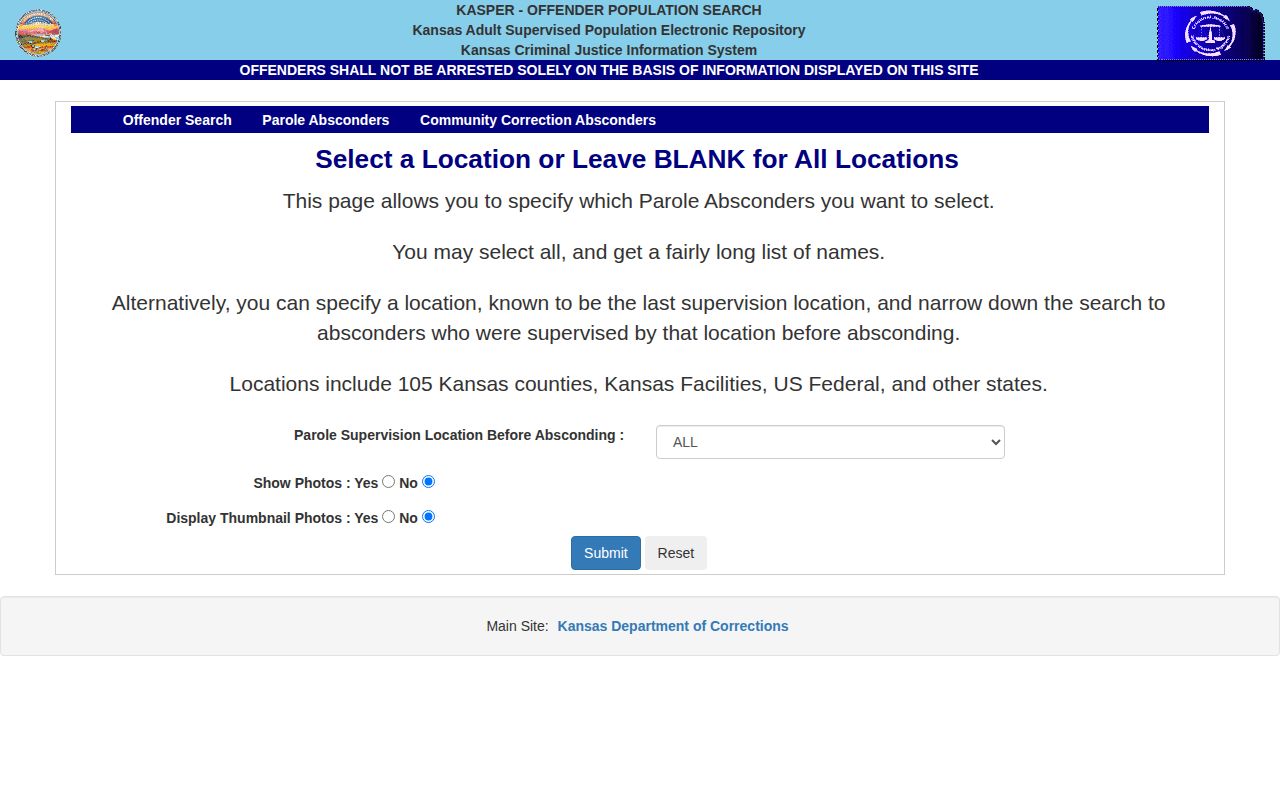
A warrant may lead to arrest, a violation hearing, or revocation. K.S.A. 22-3716 separately governs many probation-violation proceedings and possible sanctions. Old captures and copied lists are poor evidence of current status, so note the update date and seek a live agency confirmation.
Sheridan County Supervision Terms
Kansas records use closely related terms for different milestones. Keeping them separate prevents a prison release from being mistaken for the end of a sentence.
- Parole
- Conditional community release under an eligible sentence after board action.
- Postrelease supervision
- A required community-supervision period after the prison part of many determinate sentences.
- Probation
- Court-ordered community supervision, often in place of some confinement.
- Absconder
- A supervised person alleged to have stopped complying or whose location is unknown.
- Revocation
- An official action ending community placement and potentially returning the person to custody.
- Discharge
- The formal end of the correctional or supervision obligation.
Conditions can include reporting, approved residence or travel, treatment, fees, and compliance with law, but only the actual order controls. A violation allegation is not the same as a final finding. Use the court order or KDOC action document for the exact result.
Ending Sheridan County Supervision
Supervision ends by formal discharge, not merely by the passage of an estimated date. KDOC can document discharge from parole or postrelease supervision. A Sheridan County court can enter an order ending probation, extending it, modifying it, or revoking it. KASPER may preserve correctional history, while the district docket may preserve the sequence of court orders.
This date can matter beyond the supervision file. Kansas expungement waiting periods for some eligible convictions are measured from sentence satisfaction or discharge. K.S.A. 21-6614 has varying periods and exclusions, so the correct offense and final order are essential. Request the actual discharge record rather than assuming that a person who is no longer on an active list has completed every duty.
Kansas open-records law favors access to public records unless a specific rule permits or requires closure. It does not require an office to create a new supervision summary. A narrow request for an existing discharge order, board action, or public status field is more useful than asking staff to reconstruct the whole case. Request electronic copies when practical and ask for the cited legal basis if part of a record is withheld.
Kansas VINE is useful for participating county-jail custody changes, but it does not include KDOC residents in state prisons and is not a supervision-discharge registry. KBI registration is also separate. A person may have a registry duty after release without being on parole, and most released people do not appear in that registry.